Building
Lindesay
Sydney's earliest surviving residence, on the Darling Point peninsula.
Lindesay was raised on the southern fold of the Darling Point peninsula in 1834 — eleven years after the colony's first land grants on the headland, and well before the suburb itself had been named. It survives, almost intact, as Sydney's oldest domestic Gothick villa and the oldest surviving residence in the postcode now known as 2027.
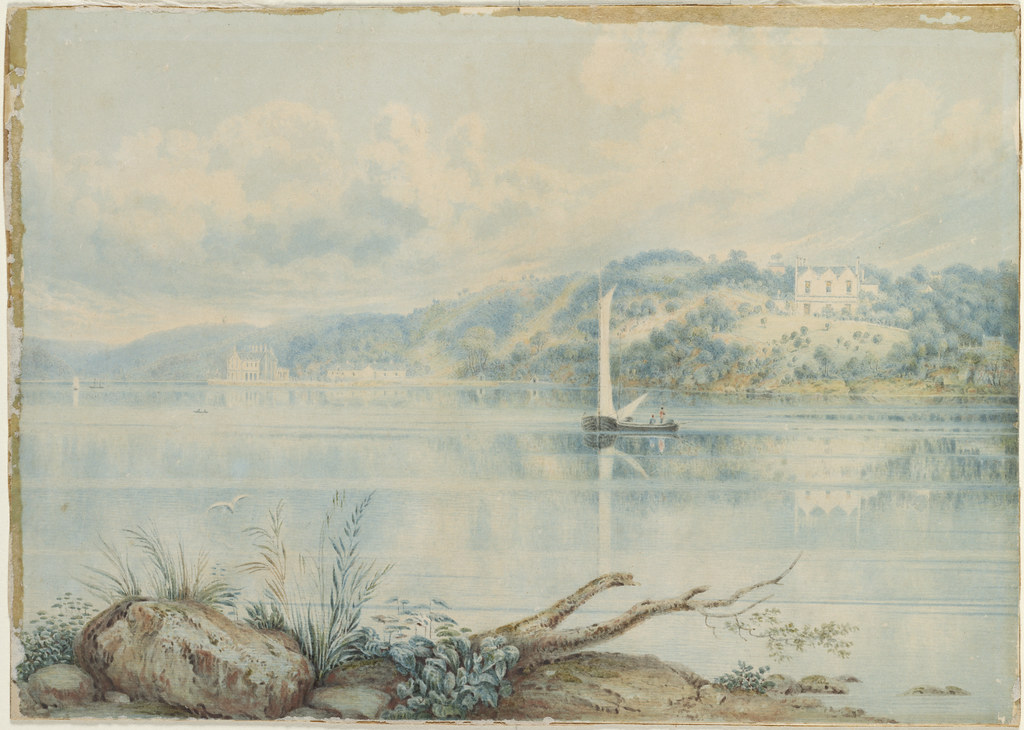
The villa was commissioned by Campbell Drummond Riddell, who had arrived in the colony in 1830 to take up the post of Colonial Treasurer of New South Wales. At the colonial subdivision auction of 1833, Riddell paid for a wooded slope above what people were then still calling Mrs Darling's Point. He gave the design to John Verge, then in his late Sydney period and at the top of his form.
What Verge produced was, for the colony, architecturally radical: the first domestic essay in the picturesque Gothick mode, decades before the heavier Gothic Revival turned up in earnest. The steeply pitched gables, the drip-moulded windows, the crenellated parapet were borrowed wholesale from English country cottages of the late Regency. It was finished in 1836. The building accounts survive, and they are eye-watering for their date.
The site, and what it commands
Lindesay sits on a sloping site of just over an acre, falling away to the south and east toward the bay. The principal rooms (a single-storey arrangement of drawing room, library, dining room and study) are oriented to the long view across Double Bay and the open harbour beyond. Originally the land below was terraced down to a private water frontage. Subsequent subdivisions have narrowed the parcel, but the outlook is essentially unchanged.
The villa is, in this sense, the prototype of every Darling Point house that followed. The pattern Verge set down at Lindesay (single-storey, picturesque, oriented for the harbour, behind a walled garden) became the template for the next century of building on the peninsula. Carthona, raised five years later by Sir Thomas Mitchell at the water's edge, follows the same basic intelligence; so do The Swifts, Cloncorrick and the heritage villas that survive on Greenoaks Avenue.
Ownership, in three families
Riddell held the property until his death in 1858, after which the villa passed to a succession of colonial professionals: William Bowman, a noted surgeon, and the Allen family of solicitors, in whose hands it remained for several generations. By the early twentieth century Lindesay was one of the few first-generation Darling Point houses to have escaped demolition or unsympathetic alteration. The other early villas of comparable importance, including Greenoaks (now part of the Bishopscourt grounds), Carrington, and the original Yarranabbe House, had by then been substantially remodelled or lost.
In 1963 the National Trust of Australia (NSW) acquired it. They have held and maintained it since. It was the Trust's first acquisition in New South Wales and remains its most architecturally significant Sydney house. The interiors retain their original cedar joinery and many of the early fireplace surrounds. The grounds, though much reduced, are kept to a Verge-period planting scheme; the harbour view, which is what the building was set to face, is substantially intact.
What Lindesay tells you about the peninsula
Lindesay matters because it is the headwater of an architectural tradition that the peninsula has, with unusual consistency, continued to honour. The villa was designed for an owner who could afford the harbour outlook and who chose restraint over display. The houses around it for the next two centuries did the same. The peninsula's preference for walled gardens, low-density siting, long-held stewardship and long horizons begins here, in 1834, in the careful hand of John Verge.
For visitors, Lindesay is the single most useful stop in understanding Darling Point. It is where the place's habits begin.